During Breast Cancer Prevention Month, GrassrootsHealth celebrates the remarkable scientists and advocates whose work helped uncover the relationship between sunlight, vitamin D, and cancer and whose shared legacy continues to inspire a future focused on prevention.
Key Points
- The pioneering research of Drs. Frank and Cedric Garland helped establish the connection between sunlight, vitamin D, and cancer prevention more than 45 years ago.
- Drs. Edward Gorham and William Grant expanded the evidence linking sunlight and vitamin D with reduced cancer risk, including breast cancer.
- Dr. Joan Lappe’s groundbreaking clinical trials advanced vitamin D and cancer prevention research, highlighting the importance of achieved vitamin D blood levels.
- GrassrootsHealth founder Carole Baggerly united scientists and brought their research into practice, creating a lasting legacy honored through the Baggerly-Garland Awards on November 2.
What began as an observation more than 50 years ago would help launch decades of research investigating sunlight, vitamin D, and the prevention of cancer and other chronic diseases. Behind this research are individuals whose careers, discoveries, and personal stories became deeply intertwined: Dr. Frank Garland, Dr. Edward Gorham, Dr. William Grant, Dr. Joan Lappe, and GrassrootsHealth founder Carole Baggerly.
Together, their contributions helped establish a scientific foundation for understanding vitamin D as a potentially important factor in cancer prevention, while challenging researchers to look beyond supplementation alone and consider the vitamin D levels people achieve as the true measure of vitamin D status. This October, as GrassrootsHealth recognizes Breast Cancer Prevention Month, we honor their remarkable contributions and the shared vision that connects them.
It Began with Two Brothers and a Map
In the 1970s, brothers Drs. Cedric and Frank Garland were attending a scientific presentation at Johns Hopkins University when something caught their attention. The presentation included color-coded maps showing cancer mortality rates across the United States. They noticed a striking geographic pattern: death rates from colon cancer were substantially higher in northern regions receiving less sunlight than in sunnier southern regions.

Both brothers had been fascinated by the sun since childhood. Now, as emerging epidemiologists, they recognized that this pattern might hold an important clue about cancer prevention. They proposed that differences in sunlight exposure and the vitamin D produced when ultraviolet B (UVB) radiation reaches the skin might help explain differences in cancer mortality. In 1980, they published their landmark paper, Do Sunlight and Vitamin D Reduce the Likelihood of Colon Cancer?, helping establish an entirely new direction in cancer epidemiology.
 Dr. Frank C. Garland (1950–2010) devoted much of his career to pursuing that possibility. After earning his doctorate in epidemiology from Johns Hopkins, he moved back to San Diego, where he conducted extensive research on cancer and chronic disease among naval personnel and served as an adjunct professor at UC San Diego. His research eventually encompassed numerous cancers, including breast, ovarian, colon, and endometrial cancers. Beyond his scientific accomplishments, Frank was a devoted naturalist whose fascination with the sun, wildlife, and the environment reflected the curiosity that helped define his scientific career.
Dr. Edward Gorham: Following the Evidence Across the Globe
 When epidemiologist Dr. Edward D. Gorham joined forces with the Garland brothers, their collaboration opened new opportunities to investigate the relationship between sunlight and cancer. Dr. Gorham began his career studying pancreatic cancer in Imperial County, California, using the hands-on methods of classical epidemiology, before turning his attention to sunlight, vitamin D, and chronic disease.
In 1989, Gorham and the Garland brothers published an important study examining air pollution and cancer mortality in 20 Canadian cities. They found that cities with higher concentrations of sulfate air pollution, which can reduce the amount of solar UVB reaching the ground, had higher mortality rates from breast and colon cancer. The following year, Gorham led another groundbreaking study examining breast cancer incidence across the former Soviet Union, finding that breast cancer incidence was approximately twice as high in northern Soviet republics as in sunnier southern regions.
These findings extended the geographic evidence beyond North America and strengthened the hypothesis that sunlight exposure might influence cancer risk. Over his career, Dr. Gorham contributed to approximately 150 biomedical publications and reports, including research on breast cancer, diabetes, multiple sclerosis, and other conditions. His work helped move the original Garland hypothesis from an intriguing geographic observation toward a broader body of epidemiological evidence.
Dr. William Grant: Expanding the Evidence for Vitamin D and Disease Prevention
 Dr. William B. Grant brought an unusual combination of expertise to the field. He began his scientific career in physics and atmospheric research, working with institutions including NASA’s Jet Propulsion Laboratory. His work studying atmospheric ozone and aerosols gave him a valuable perspective on the factors influencing how much ultraviolet radiation reaches Earth’s surface and, ultimately, human health.
In 2002, Dr. Grant published a major analysis examining geographic variations in cancer mortality across the United States, identifying additional cancers for which mortality rates were inversely associated with solar UVB exposure. He subsequently collaborated with Dr. Cedric Garland on research investigating whether other geographic and lifestyle factors could explain these associations.
Dr. Grant founded the Sunlight, Nutrition, and Health Research Center (SUNARC) in 2004 and has authored or coauthored hundreds of scientific publications examining vitamin D, sunlight, nutrition, and disease. His work has expanded the discussion beyond cancer to include cardiovascular disease, infectious diseases, and other major public health concerns. He has also emphasized the challenges of studying nutrients and sunlight using conventional randomized clinical trials and the importance of considering multiple forms of scientific evidence.
Dr. Joan Lappe: Bringing Vitamin D Research into Clinical Trials
As epidemiological evidence linking sunlight and vitamin D with cancer risk continued to grow, another important question emerged: Could increasing vitamin D intake reduce cancer incidence in a randomized clinical trial?
 Dr. Joan M. Lappe, a distinguished researcher at Creighton University, helped address this question. She joined the research team of renowned vitamin D and bone health scientist Dr. Robert Heaney in 1988 and developed an internationally recognized research career focused on calcium, vitamin D, osteoporosis, and cancer prevention.
In 2007, Dr. Lappe and her colleagues published a landmark randomized controlled trial involving 1,179 postmenopausal women in rural Nebraska. The study found that women assigned to receive vitamin D3 and calcium experienced approximately 76% lower cancer incidence when cancers diagnosed during the first year were excluded, compared with women receiving placebo. This finding helped bring vitamin D and cancer prevention research into a new phase of clinical investigation.
Dr. Lappe followed this work with a second large randomized trial, published in JAMA in 2017, involving more than 2,300 women. Although the difference in overall cancer incidence between the treatment and placebo groups did not meet conventional statistical significance, a post hoc analysis examining the vitamin D blood levels participants actually achieved revealed a statistically significant inverse association with cancer incidence (p=0.03). In that analysis, an achieved serum 25(OH)D concentration of 55 ng/mL was associated with an estimated 35% lower cancer risk compared with 30 ng/mL.

Her work reinforced an important research question: Is the amount of vitamin D a person takes the most meaningful measure, or is the concentration of vitamin D achieved in the bloodstream more relevant to health outcomes?
Carole Baggerly: Turning Scientific Discovery into Public Health Action
 Scientific discoveries can take decades to influence public health recommendations. Carole Baggerly (1942–2024) believed people should have access to important research that could help them make informed decisions about their health.
After meeting with leading vitamin D scientists and learning about the growing evidence connecting vitamin D with disease prevention, Carole recognized a critical gap between what researchers were discovering and what the public was being told. She was especially interested in the significance of an individual’s achieved serum 25-hydroxyvitamin D [25(OH)D] concentration and the importance of measuring vitamin D blood levels rather than focusing only on supplement doses.
In 2007, Carole founded GrassrootsHealth, a nonprofit public health research organization dedicated to moving vitamin D research into practice. With the support of leading scientists, including Drs. Cedric Garland, Joan Lappe, Edward Gorham, and William Grant, she helped build a collaborative effort connecting research, education, and public participation.
In 2008, GrassrootsHealth launched the D*action study, a large population-based field trial that empowered individuals to measure and improve their vitamin D status while contributing to scientific research. Carole’s vision helped bring new attention to the relationship between achieved vitamin D levels and disease outcomes, including breast cancer. Her efforts also extended into maternal and infant health, prenatal vitamin D research, and practical educational resources for individuals and healthcare practitioners.
Breast Cancer Prevention: A Shared Scientific Legacy
The connection between these five individuals is particularly meaningful during Breast Cancer Prevention Month. Their research and advocacy contributed to a growing body of evidence suggesting that vitamin D status may be an important, potentially modifiable factor in breast cancer risk.
The early geographic investigations of the Garland brothers and Dr. Gorham helped establish the hypothesis that sunlight exposure might influence breast cancer incidence and mortality. Dr. Grant expanded the epidemiological evidence, while Dr. Lappe brought vitamin D research into randomized clinical trials. Carole Baggerly helped bring these researchers and their findings together through GrassrootsHealth, creating opportunities to investigate the relationship between vitamin D status and breast cancer risk in large populations.
One particularly important result of this collaboration was a 2018 pooled analysis involving 5,038 women, combining data from two randomized trials and the GrassrootsHealth prospective cohort. The analysis, led by GrassrootsHealth researcher Sharon McDonnell and coauthored by Carole Baggerly, Drs. Cedric Garland, Edward Gorham, Joan Lappe, and colleagues, found that women with serum 25(OH)D concentrations of 60 ng/mL or higher had an 82% lower incidence of breast cancer compared with women whose levels were below 20 ng/mL.
Although this observational association does not by itself establish that raising vitamin D levels will produce the same reduction in breast cancer risk, it represents an important finding that deserves continued investigation.
Screening and early detection save lives, but prevention requires looking earlier, at the nutritional, environmental, and lifestyle factors that may influence cancer risk over a lifetime. Vitamin D is one promising area of that research, and the individuals honored here have played a significant role in bringing it to public attention.
Honoring Their Legacy: The Baggerly-Garland Awards
 On November 2, 2026—World Vitamin D Day—GrassrootsHealth will join partners and supporters in celebrating the inaugural Baggerly-Garland Awards, named in honor of two individuals whose contributions helped shape the field: Carole Baggerly and Dr. Frank Garland.
This year’s honorees are Dr. Edward D. Gorham, Dr. William B. Grant, and Dr. Joan M. Lappe, whose achievements represent different but complementary approaches to scientific discovery. Some began by studying geographic patterns of disease, while others investigated environmental exposures, analyzed large populations, or conducted randomized clinical trials. Together, they have helped build a scientific story that spans generations.
The most meaningful way to honor these pioneers is not simply to recognize what they discovered, but to continue asking the questions their work inspired. What additional cancers might be influenced by vitamin D status? How early in life should prevention begin? What blood levels are associated with the greatest benefits? And how can research findings be translated responsibly into effective public health strategies?
During Breast Cancer Prevention Month and on November 2, World Vitamin D Day, we celebrate not only the achievements of these extraordinary individuals, but also the possibility of a future in which preventing cancer receives as much attention as detecting and treating it.
Their shared legacy reminds us that prevention begins with curiosity, advances through rigorous science, and reaches its greatest potential when knowledge is put into practice.
Join us on November 2 for the Baggerly-Garland Awards Ceremony and Press Conference as we celebrate these remarkable individuals and their contributions to the science of vitamin D and disease prevention.
Visit the event page and RSVP to attend in person or virtually.
Please share this invitation with friends, colleagues, health professionals, and others interested in vitamin D research. Help us celebrate the people whose work continues to inspire new questions and possibilities for prevention.
Interested in Being a Media Partner for this Event? Contact jen@grassrootshealth.org and view our media kit here.
Learn More About the Awards and RSVP
Selected Scientific References
- Garland CF, Garland FC. Do sunlight and vitamin D reduce the likelihood of colon cancer? International Journal of Epidemiology. 1980;9(3):227–231.
- Gorham ED, Garland CF, Garland FC. Acid haze air pollution and breast and colon cancer mortality in 20 Canadian cities. Canadian Journal of Public Health. 1989;80(2):96–100.
- Gorham ED, Garland FC, Garland CF. Sunlight and breast cancer incidence in the U.S.S.R. International Journal of Epidemiology. 1990;19:820–824.
- Grant WB. An estimate of premature cancer mortality in the U.S. due to inadequate doses of solar ultraviolet-B radiation. Cancer. 2002;94(6):1867–1875.
- Lappe JM, et al. Vitamin D and calcium supplementation reduces cancer risk: results of a randomized trial. American Journal of Clinical Nutrition. 2007;85(6):1586–1591.
- Lappe JM, et al. Effect of vitamin D and calcium supplementation on cancer incidence in older women: a randomized clinical trial. JAMA. 2017;317(12):1234–1243.
- McDonnell SL, et al. Breast cancer risk markedly lower with serum 25-hydroxyvitamin D concentrations ≥60 vs <20 ng/mL: pooled analysis of two randomized trials and a prospective cohort. PLOS ONE. 2018;13(6).
Measuring Your Level is Important… Are You Getting Enough Vitamin D?
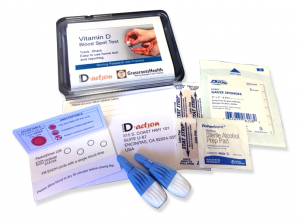
The only way to know is to test your levels! Testing versus blind supplementation is essential to know for sure if what you are taking is the right amount for you. Once you test your vitamin D (and other levels) to know where you are NOW, you can account for any upcoming changes in lifestyle over the coming months and adjust your intake to reach (or maintain) your targets.
 Measure your:
- Vitamin D
- Magnesium PLUS Elements
- Omega-3 Fatty Acids
- hsCRP
- HbA1c
- TSH
- Type 1 Diabetes Autoantibodies
Did you know that each of the above can be measured at home using a simple blood spot test? As part of our ongoing research project, you can order your home blood spot test kit to get your levels, followed by education and steps to take to help you reach your optimal target levels. Start by enrolling and ordering your kit to measure each of the above important markers, and make sure you are getting enough of each to support better mood and wellbeing!
Create your custom home test kit today. Take steps to improve the status of each of these measurements to benefit your overall health. With measurement you can then determine how much is needed and steps to achieve your goals. You can also track your own intakes, symptoms and results to see what works best for YOU.