Awareness matters when it translates into action. What actions can be taken to help prevent breast cancer?
Key Points
- October is Breast Cancer Prevention Month at GrassrootsHealth, because awareness should include learning what actions may help reduce the risk of developing breast cancer in the first place.
- A GrassrootsHealth pooled analysis of 5,038 women found 82% lower breast cancer incidence among women with vitamin D levels ≥60 ng/mL compared with <20 ng/mL.
- Join Dr. Joan Lappe on October 21 for a special Vitamin D Study Hour examining her landmark randomized trials and what achieved vitamin D levels may tell us about cancer prevention.
- Join us virtually on November 2, World Vitamin D Day, for the inaugural Baggerly-Garland Awards honoring Drs. Gorham, Grant, and Lappe and decades of research on vitamin D, sunlight, and cancer prevention.

Every October, for “Breast Cancer Awareness Month,” breast cancer receives much-needed attention. At GrassrootsHealth, we have long called October Breast Cancer Prevention Month. Yes, finding breast cancer earlier and improving treatment are critically important, but preventing as many cases as possible before they ever occur should receive just as much or even more attention.
The American Cancer Society estimates that 321,910 women in the United States will be diagnosed with invasive breast cancer in 2026, with another 60,730 cases of ductal carcinoma in situ (DCIS). An estimated 42,140 women will die from breast cancer this year. Breast cancer incidence has also been increasing, rising approximately 1% per year overall from 2013 to 2022 and even faster among women under age 50.
This year, the American Cancer Society is putting greater attention on modifiable breast cancer risk factors and the actions women can take to help reduce their risk. Its Breast Cancer Awareness Month message highlights a new survey examining the gap between simply knowing about breast cancer risk factors and actually taking action to address them. The organization estimates that more than 30% of breast cancers are considered preventable through healthy behaviors that can reduce risk, including regular physical activity, maintaining a healthy weight, avoiding alcohol and tobacco, and breastfeeding when possible.
As the American Cancer Society put it, “It’s not enough to raise awareness;” awareness needs to translate into action, and there are several actions that can reduce cancer risk. Which is exactly why GrassrootsHealth has called October Breast Cancer PREVENTION Month for years.
Unfortunately, there is one important and highly modifiable factor missing from their prevention conversation: vitamin D status.
Decades of research have investigated the relationship between vitamin D and breast cancer, with numerous studies finding lower breast cancer risk among women with higher vitamin D blood levels. Unlike many breast cancer risk factors that cannot be changed, vitamin D status can be measured and modified. Testing vitamin D levels and correcting low vitamin D status can be relatively simple and inexpensive, making it an especially important factor to consider as part of a broader breast cancer prevention strategy.
This October, we continue to bring this research into the prevention conversation alongside other factors that may influence breast cancer risk.
What Does the Research Tell Us About Vitamin D and Breast Cancer?
The relationship between vitamin D and breast cancer has been studied from many different directions, including geographic and sunlight studies, observational research, randomized controlled trials, and studies examining achieved vitamin D blood levels.
Much of this research has been summarized in a Breast Cancer Research Statistics Sheet created for the media surrounding our inaugural Baggerly-Garland Vitamin D Scientist Awards.
Among the findings highlighted:
82% lower breast cancer incidence with higher vitamin D levels (McDonnell et al., 2018)
A 2018 pooled analysis led by GrassrootsHealth researchers included 5,038 women from two randomized controlled trials and the GrassrootsHealth prospective cohort. Women with vitamin D concentrations of 60 ng/mL or higher had an 82% lower incidence of breast cancer compared with women whose levels were below 20 ng/mL.
Sunlight and UV exposure have also been associated with lower breast cancer risk (Li & Ma, 2020)
A 2020 meta-analysis found that women with the highest levels of solar ultraviolet exposure had approximately a 30% lower breast cancer risk compared with those with the lowest exposure. This builds on decades of epidemiological research investigating geographic differences in cancer incidence and mortality and their relationship to sunlight and UVB exposure.
Vitamin D matters after diagnosis as well
A 2018 study of 5,417 women with breast cancer found a 49% lower risk of breast cancer mortality among women who began vitamin D supplementation within six months of diagnosis (Madden et al., 2018). More recent research continues to examine vitamin D status in relation to survival, treatment response, recurrence, and recovery.
These findings do not mean vitamin D alone determines whether someone develops or survives breast cancer. Cancer is complex, and many factors contribute to risk. But taken together, this body of research raises an important public-health question:
Should knowing and addressing vitamin D status be a more routine part of breast cancer prevention and health?
At GrassrootsHealth, we believe the answer to that question is an absolute YES. Throughout the month, we will review several of the studies that support this position in more detail.
Wednesday, Oct. 21: Learn Directly from Award Recipient Dr. Joan M. Lappe
 One of the scientists who has spent decades investigating vitamin D and cancer is Joan Lappe, PhD, RN, FAAN. This month you will have a special opportunity to hear from her directly. On Wednesday, October 21, Dr. Lappe will join GrassrootsHealth for a special Vitamin D Study Hour:
Vitamin D in Breast Cancer Prevention
Dr. Lappe will review her landmark 2007 and 2017 randomized controlled trials in postmenopausal women and discuss what those studies taught us about vitamin D status and cancer risk. Join us as Dr. Lappe explains the research, its history, and what she believes we have learned about vitamin D and breast cancer prevention.
Monday, Nov. 2: Join Us for the Inaugural Baggerly-Garland Awards
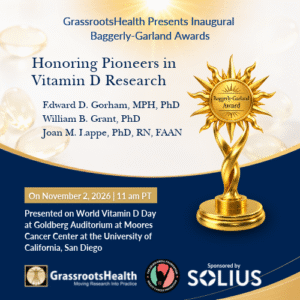 Breast Cancer Prevention Month will lead into another very special event. On World Vitamin D Day, Monday, November 2, GrassrootsHealth will present the inaugural Baggerly-Garland Vitamin D Scientist Awards at the Moores Cancer Center at the University of California San Diego, honoring three scientists whose pioneering work has helped advance our understanding of vitamin D, sunlight, and cancer prevention:
- Edward D. Gorham, MPH, PhD
- William B. Grant, PhD
- Joan M. Lappe, PhD, RN, FAAN
Date: Monday, November 2, 2026
Time: 11:00 AM Pacific / 2:00 PM Eastern
Location: Goldberg Auditorium, Moores Cancer Center at UC San Diego Health
Attendance: In person in San Diego or virtually via Zoom
The inaugural awards are made possible through the generous sponsorship of Solius Labs. GrassrootsHealth is also proud to partner with the Helen Knoll Foundation to expand public awareness of vitamin D research in breast health and cancer prevention.
Visit the event page and RSVP to attend in person or virtually.
Please share this invitation with friends, colleagues, health professionals, and others interested in vitamin D research. Help us celebrate the people whose work continues to inspire new questions and possibilities for prevention.
Interested in Being a Media Partner for this Event? Contact jen@grassrootshealth.org and view our media kit here.
Measuring Your Level is Important… Are You Getting Enough Vitamin D?
The only way to know is to test your levels! Testing versus blind supplementation is essential to know for sure if what you are taking is the right amount for you. Once you test your vitamin D (and other levels) to know where you are NOW, you can account for any upcoming changes in lifestyle over the coming months and adjust your intake to reach (or maintain) your targets.
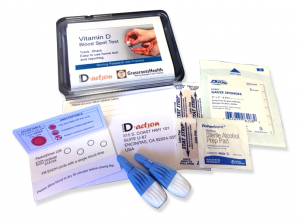 Measure your:
- Vitamin D
- Magnesium PLUS Elements
- Omega-3 Fatty Acids
- hsCRP
- HbA1c
- TSH
- Type 1 Diabetes Autoantibodies
Did you know that each of the above can be measured at home using a simple blood spot test? As part of our ongoing research project, you can order your home blood spot test kit to get your levels, followed by education and steps to take to help you reach your optimal target levels. Start by enrolling and ordering your kit to measure each of the above important markers, and make sure you are getting enough of each to support better mood and wellbeing!
Create your custom home test kit today. Take steps to improve the status of each of these measurements to benefit your overall health. With measurement you can then determine how much is needed and steps to achieve your goals. You can also track your own intakes, symptoms and results to see what works best for YOU.