The buttons above the results narrow things down without typing anything.
Popular searches
Tip: quotation marks narrow a search
The buttons above the results narrow things down without typing anything.
Popular searches
Tip: quotation marks narrow a search
Vitamin D is essential for everyone, but especially for growing children.
Unfortunately, many children are not getting enough vitamin D, and the problem seems to worsen as they age.
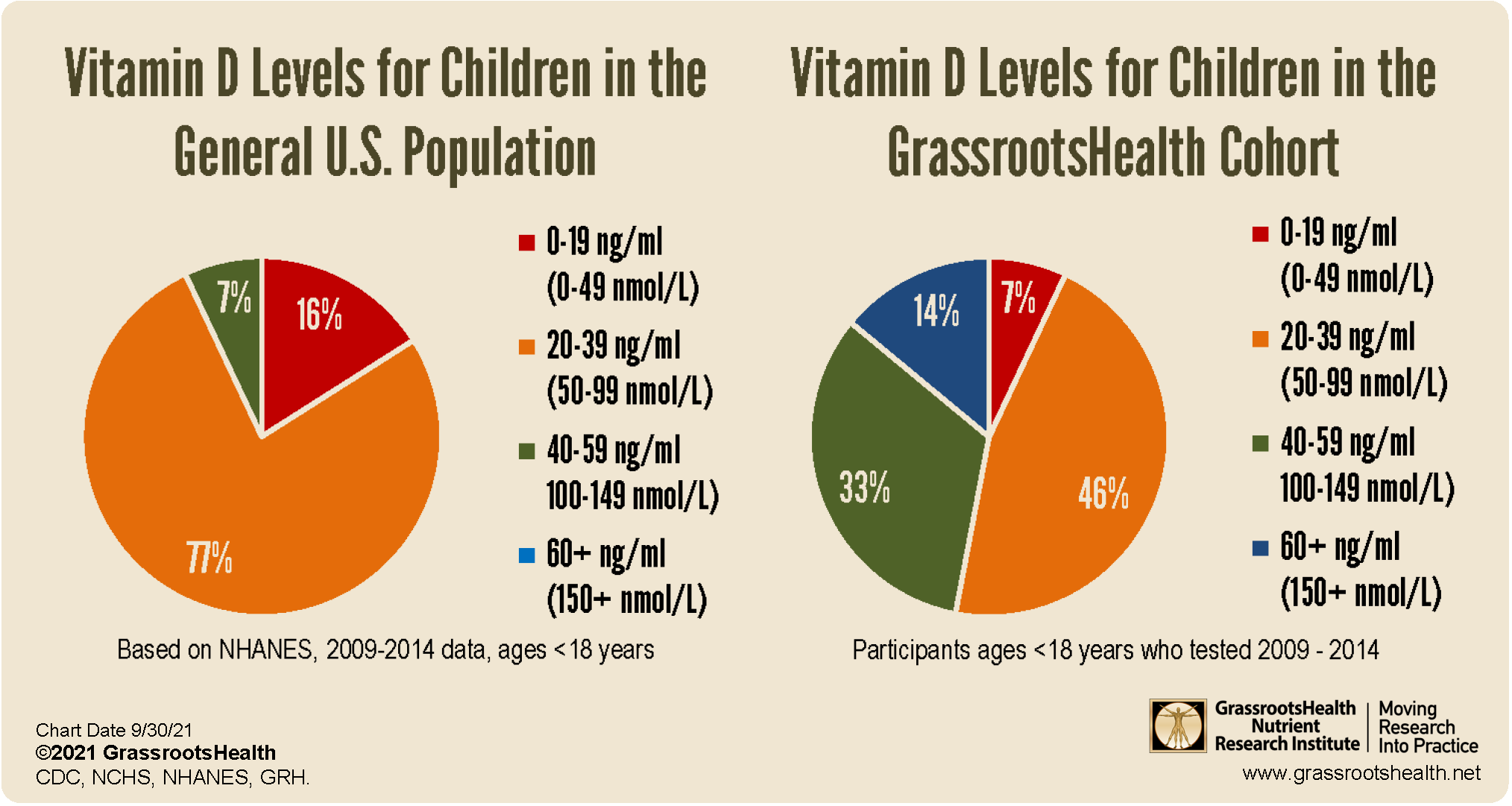
According to 2009-2014 data from the National Health and Nutrition Examination Survey (NHANES) on children under the age of 18 in the United States, 93% had vitamin D levels below 40 ng/ml (100 nmol/L), with 16% of them below 20 ng/ml (50 nmol/L). That data is charted below next to data on children in the GrassrootsHealth cohort, among whom over 50% are still below the recommended 40 ng/ml, regardless of the fact that the parents testing their children through the project are educated enough about vitamin D to be measuring levels on their own.
In a past analysis of vitamin D intake and levels among children in the GrassrootsHealth cohort, we discovered that as the age of the children increased, the percent of children with levels at or above 40 ng/ml decreased, from about two-thirds for those 0-4 years to about one-third for those 13-17 years. We also found that, while vitamin D intake should increase as body weight increases, intake remained the same or decreased as age increased, which is likely the main cause of the decreasing vitamin D levels with age.
Testing is the first step – based on their current blood level an appropriate dose of vitamin D can then be determined. Re-testing is necessary to ensure the target blood level has been reached.
Having and maintaining healthy vitamin D and other nutrient levels can help improve your health now and for your future. Measuring is the only way to make sure you are getting enough!
Step 1
Order Your Test Kit
Order your home vitamin D test kit
(Include other nutrients or levels of your choice).
Step 2
Questionaire
Complete the questionnaire about your child’s health and habits, including supplement intake and sun exposure. This helps identify why a vitamin D level may or may not be as expected, and it contributes to our research as well!
Step 3
Review Your Results
Get your child’s vitamin D result – it will be posted to your child’s online account.
GrassrootsHealth scientists recommend a vitamin D level of 40-60 ng/ml (100-150 nmol/L) Is your child’s level where you want it to be? If so – GREAT! Keep up the good work and continue participating in the project to provide more data on what it means for children to have a healthy vitamin D level.
If your child’s vitamin D level is not in your target range, follow the next steps:
Step 4
D*calculator
Use the D*calculator to determine an adjusted vitamin D supplement amount and educate yourself on other factors that affect vitamin D levels.
Step 5
Track
Track their changes and re-test in 3-6 months (or sooner if trying a loading dose).
Step 6
Goal
How did your changes affect your child’s vitamin D level? Did you reach your goal? Determine if additional adjustments are needed… repeat again if necessary.
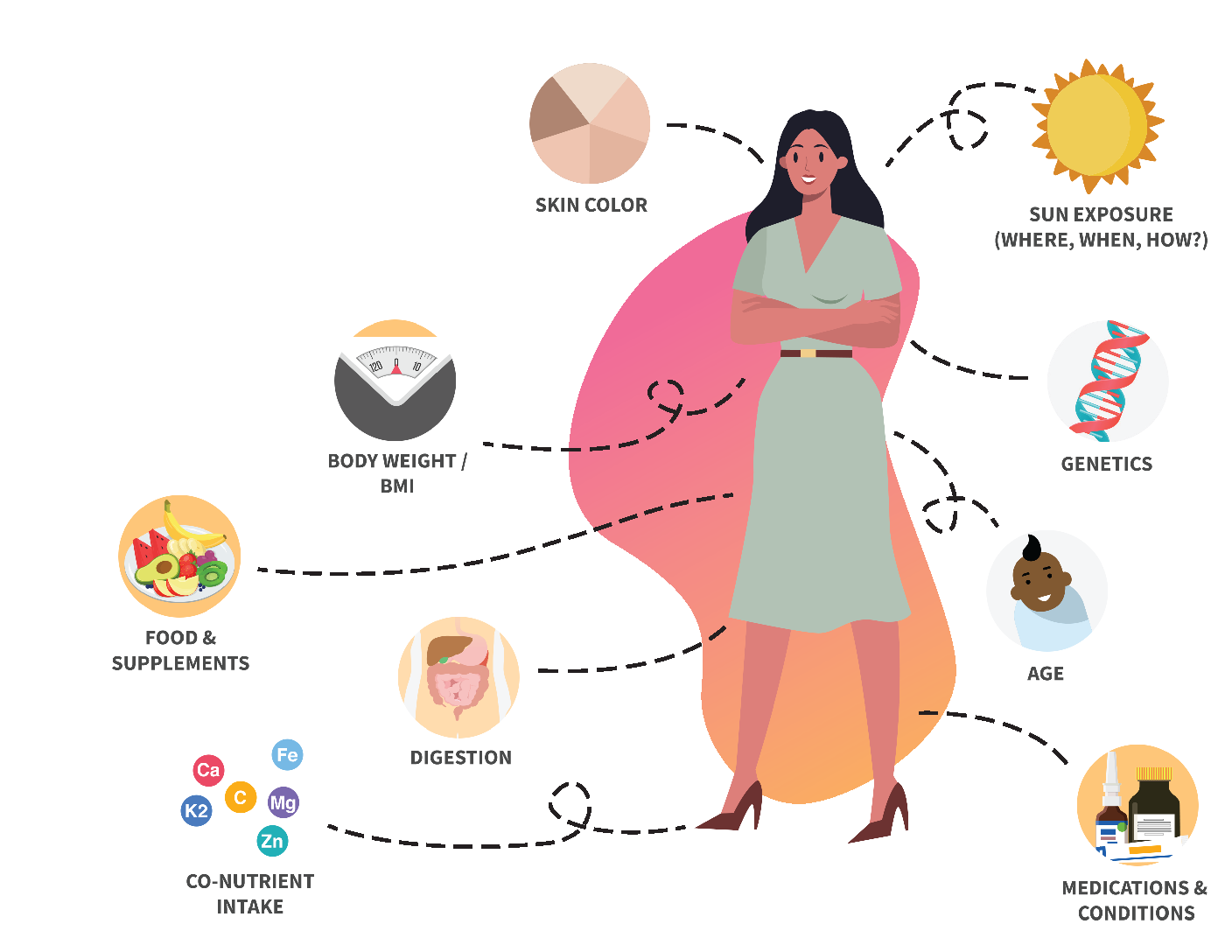
Everyone responds differently to vitamin D… For the same dose taken, individual vitamin D level response can vary by a factor of six or more. In other words, what might be enough vitamin D for one person may not be enough for another. On top of all that, children are constantly growing, and as they grow, so does the amount of vitamin D their body needs.
Vitamin D is needed by virtually every cell in the body, and is essential for hundreds of processes each and every day. It acts as a protector and regulator of all cell types, tissues, and organs, and is able to enhance the functioning of each system of the body to help keep us healthy.
Brain
Depression & Anxiety Schizophrenia, Alzheimer’s Disease, ADHD & Autism
Circulatory
High Blood Pressure, Peripheral Artery Disease, Coronary Heart Disease, Atrial Fibrillation
Respiratory
Colds & Flu, Pneumonia & Acute Respiratory Distress Syndrome (ARDS), Asthma, Tuberculosis
Muscle
Neuromuscular Pain, Weakness, Injury
Bone
Rickets, Osteoporosis Fracture
Auto-Immune Diabetes
Chrohn’s Disease, Cancer, Multiple Sclerosis, Psoriasis
Reproductive
Infertility, Preterm Birth & Prenatal Complications
And MORE!